Investment funds in Europe
In this post we're going to talk about investment funds and their behaviour both at the Spanish and European level, focusing on investment in startups.
In this post we’re going to talk about investment funds and their behaviour both at the Spanish and European level, focusing on investment in startups.

Investment funds – Itnig Fund pitch to investors
Before we start we’ll explain what an investment fund is and what types there are so we can understand what we’re analysing. Besides studying in depth how investments in startups have behaved this year, you’ll find a detailed list of the main venture capital firms in Spain.
If before learning more about investment funds you want to learn about which financing tools are most suitable for a startup, we recommend you read our article How to finance a startup and the types of investment needed at each stage.
What is an investment fund?
Investment funds, also known as Collective Investment Institutions (IIC), are a savings tool through investments, whose capital is made up of contributions from different savers, which means the investment is made jointly.
Participants hand over decision-making on the investment of this capital to professional managers – bank managers or independent ones – who look for the options that offer maximum profitability.
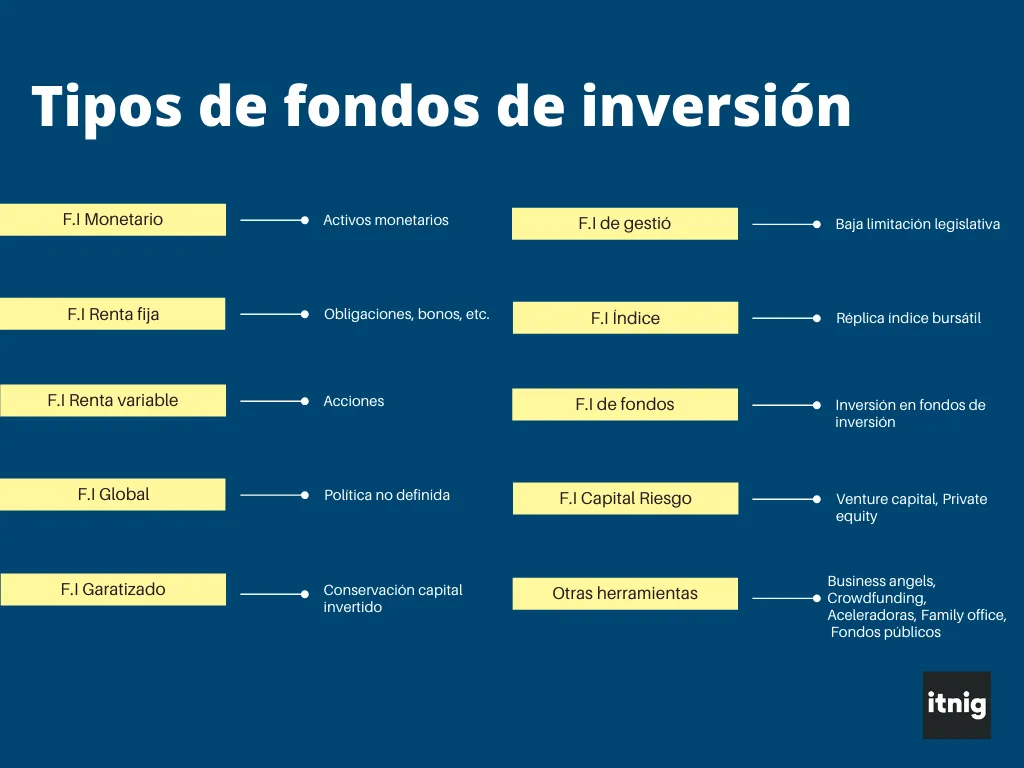
Types of investment funds
Investment funds must define an investment strategy/philosophy that specifies how assets will be distributed in the portfolio by determining the risk profile, the region invested in, and other aspects such as investment vocation. Depending on the characteristics of the strategy, the investment fund will belong to one group or another:
Money market fund
The portfolio of these investment funds is made up of monetary assets, meaning cash, short-term credit and practically liquid assets. Due to the specific structure of their investments, the risk is very low, allowing the investor to quickly convert the asset into cash without losing part of the investment made.
Fixed-income fund
In this case, the investments are directed towards bonds, treasury bills, promissory notes, etc. whose value evolution depends on the evolution of interest rates.
If it’s a short-term fixed-income fund, the maturity of the assets will be shorter, so the risk and expected profitability will also be lower. The opposite scenario is long-term investment funds, which seek long-term maturities to obtain higher profitability, but in turn face higher risk.
Equity fund
The main investment is in shares of different issuers or companies listed on the financial market. Therefore, the risk involved in investing in them is subject to the high risk usually found in these markets.
These funds tend to specialise based on different aspects such as: business sector, more or less developed markets, innovation, stock market indices, etc.
It’s worth noting that there are funds that decide to diversify their investment between fixed income and equities in order to reduce risk.
Global fund
This type of fund is characterised by not having a defined investment policy, so it can invest in any asset, market, country, currency, etc. as long as it stays within regulations.
Guaranteed fund
The very name of this type of fund explains its main characteristic. It guarantees the investor that on a given date, all or part of the capital initially invested in fixed income or equities will be preserved.
Managed investment funds
Also known as hedge funds, this is an alternative investment tool in which managers have greater decision-making power due to low regulatory limitations. What do we mean by this? Well, if an equity fund is legally limited to investing X% in a single financial asset, managed funds don’t have this restriction.
This greater flexibility when investing goes hand in hand with lower liquidity and higher risk, since all the capital could be invested in a single asset.
Fund of funds
As the name suggests, these invest in other investment funds, such as hedge funds, so that participants with less capacity to contribute capital can access higher-tier investments.
Index funds
This type of fund is dedicated to replicating the structure of a specific stock market index, based on which they create a portfolio of shares replicating the values that make up the chosen index. The goal is to obtain a return equivalent to that of the selected index.
Venture capital / private equity funds
The target investment of these investment funds is companies, preferably startups – young companies with great potential – or companies in a critical financial state; which is why the risk of these funds is considered high. Within venture capital / private equity, we find two subcategories:
Venture capital
In this group we should distinguish two types of investors in VC funds:
- General partners: these make up the fund’s investment portfolio and, additionally, get involved in managing it. GPs, besides receiving the return owed to them from the investment, also receive an annual management fee and a share of profits in the event of an exit.
- Limited partners: these limit themselves to investing their money in the fund’s capital, and leave the management process to the GPs.
This type of venture capital investor tends to invest in companies that are in the early-stage phase, meaning their product has already gone to market but they need an injection of capital to scale their business model.
Private equity
This type of investment tends to be aimed at companies that are in growth phases or that are already established in the market, a scenario where the business model has already been proven, which means the risk is lower.
Other tools
Besides venture capital and private equity, there are other tools that can serve as investment sources for startups such as:
Business angels
This is a private investor who, either independently or jointly with other partners, decides to invest their own wealth in startups, contributing what’s known as smart money. This means the investor not only contributes financial capital, but also shares their network of contacts and experience with the entrepreneur. This type of investor tends to look for companies in early phases.
Crowdfunding
This is a tool that’s becoming increasingly fashionable in the world of investment sources. There are more and more websites where entrepreneurs can publish and promote their projects for a maximum period of 120 days, during which they have the opportunity to raise the necessary investment. The contributions made to the entrepreneur are the result of users’ interest in the proposed project.
Accelerators
This is a corporate investment source. These companies offer financing and resources such as coworking spaces to the entrepreneurs they back, to ensure a high growth rate in the short term.
Family office
After the sale of the family business, the family decides to manage the wealth obtained by investing it in startups to carry out effective financial management.
Public funds
These are investment sources that come from public bodies, such as the national government or European Union projects such as EU funding programmes.
Sector analysis
Now that we’ve defined the concept of investment, and talked about the different types that exist, let’s do a deeper analysis of the startup investment market.
Investment funds in Spain
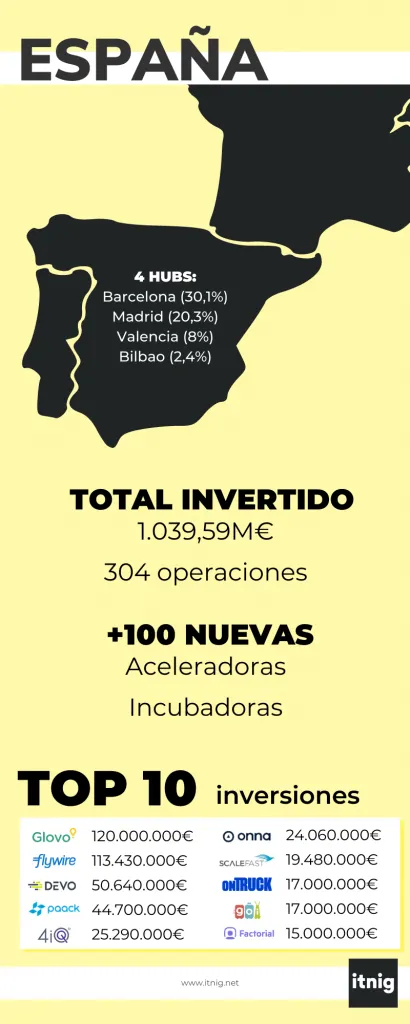
Investment funds in Spain – Market analysis by Itnig
Currently in Spain there are 4 hubs where startups are located: Barcelona (30,1%), Madrid (20,3%), Valencia (8%) and Bilbao (2,4%); so investments fluctuate between these cities.
Despite the health crisis, the sector has managed to adapt, and thanks to investors’ commitment, this section of the market has shown more positive results than expected this year, 2020. Throughout the sector’s economic year, more than 152 corporate accelerators and more than 100 incubators have appeared, which implies a growing market trend.
The total value of investments made this year is 1.039,59 million euros, although, despite being a notable amount, it’s lower than the results for 2019 and 2018. However, the number of deals has been higher. In 2019 there were 246 moves, while this year it reached 304, with the last quarter being the most successful with 80 deals closed.
Most of these deals are investments aimed at companies in pre-seed and early-stage phases, while investments in companies in more mature phases are shrinking. We can see this reflected in the top10 investments of the year by volume, where we find Itnig’s startup, Factorial, which managed to raise a funding round of 15 million euros from a Silicon Valley fund.
Of all the investment Spanish startups have received this year, approximately 65% comes from abroad, specifically from Europe, North America and the rest of the world. The remaining 35% comes from national investment.
The fund structures that have invested most this year are (from highest to lowest investment volume) venture capital, corporate, private equity and crowdfunding. This last type of source has grown its mass by 9,1%, representing 21,04 million euros of the total investment in 2020.
If we take a step back to analyse the market at the European level, we see that the behaviour isn’t the same as at the Spanish level. The first difference we see is where the funds are investing. Unlike the national case, they’re focusing more on mature stages rather than early-stage. Specifically, this 2020 there has been an average close valued at 20 million dollars in companies in mature stages.
Although the European market doesn’t bet as strongly on startups in earlier stages, we’ve seen that there’s an increase in the arrival of foreign investment at both levels (Spanish and European).
Investment funds in Europe
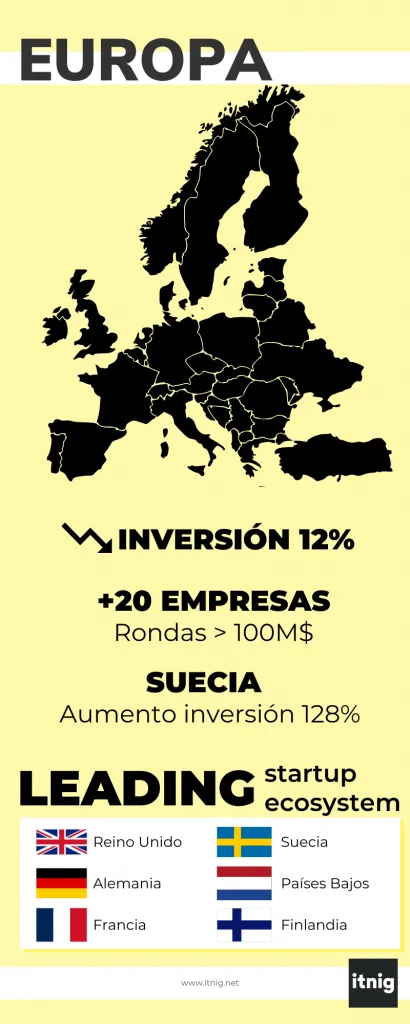
Investment funds in Europe – Market analysis by Itnig
Overall, this year, Venture Capital investments have fallen by 12% due to the pandemic. An impact lower than expected, just as in the case of the Spanish market. This behaviour isn’t alarming since by the end of 2019 a declining trend in startup investment in the European market had already begun to be seen, so the pandemic has simply accelerated it.
However, this scenario has varied a lot depending on the European city we’re looking at. Cities that have suffered more from the consequences of COVID-19, such as Barcelona or Milan, are among those with the most notable decline. On the other hand, in the case of Zurich, Helsinki, Dublin, Amsterdam, Paris, London and Oxford, the flow of investment has been positive. Although Berlin led the European investment market in 2018, London and Tel Aviv have been fighting for first place until the English capital managed to claim it with an investment volume of more than 4.000 million dollars.
In the third quarter of 2020, the leading countries for investment are: the United Kingdom, which invested 15% less than the previous year at the same time; Germany, the country that suffered the biggest decline among the four, with 28% less; France, with a 9% increase, and Sweden, whose growth is very notable, with a 128% increase compared to the third quarter of 2019.
Proof that, despite the slower pace of investment growth, there’s no need to be alarmed, is that in Q3 2020, 20 European companies managed to raise funding rounds larger than 100 million dollars, representing 45% of Venture Capital in the third quarter of 2020, higher than in the third quarter of 2019.
Investments made throughout 2020 have varied depending on the stages projects are in. Compared to 2019:
- Seed-stage: the number of deals in this type of project has fallen by 43%. However, the amounts invested have gone from 900 million to 700 million. This means investors have preferred to invest in fewer projects, but in those where they see clear growth potential, they’ve contributed a larger volume. In other words, the distribution of invested capital has narrowed.
- Early-stage: in the case of investments in early-stage startups there have been 93 fewer deals than last year. However, the amount contributed is higher, going from 4 billion to 4.1 billion dollars. This behaviour suggests that, at the European level, despite not betting on a larger number of early-stage startups, when they do contribute, they do so with greater confidence, providing larger sums of money.
- Growth-stage: the negative impact on investments in companies at this stage is 34%, a figure that isn’t very alarming when compared to the reduction in investment. Not only has there been less betting on this group of startups, but investment has also fallen by 20% compared to 2019. Despite this scenario, they remain the safe bet for European investors, having contributed 5.200 million dollars so far this year.
Broadly speaking, we can say that the two leading startup ecosystems at the European level this year are the United Kingdom – due to the cluster of leading Venture Capitals – Germany, France, Sweden, the Netherlands and Finland. The investors we find in these countries are venture capital firms as powerful as Balderton Capital (United Kingdom), Global Founders Capital and High-Tech Grunderfonds (Germany) and Bpifrance (France).
Finally, it’s worth noting that both venture capital and crowdfunding are the main investment tools that startups have relied on this year, in the first case due to the volume of investments made, and in the second due to the increase in deals made in proportion to last year.
Key players in Venture Capital in Spain
The Spanish investment fund market is growing year after year, but as in all sectors, there are leaders dominating the startup financing industry. As mentioned in the sector analysis, large-volume deals have taken place, and the key players are the following:
AXON PARTNERS
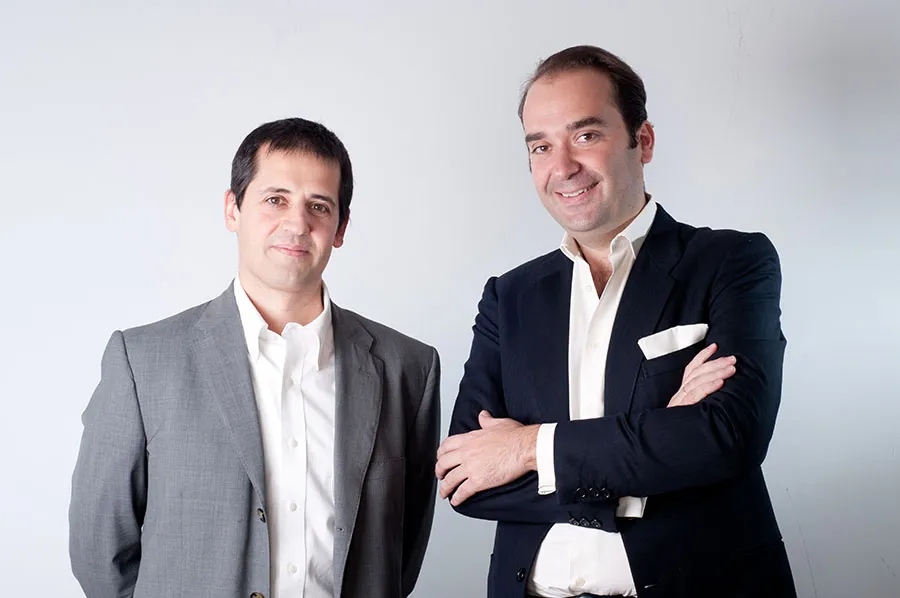
Francisco Velázquez and Alfonso de León – Founders of Axon Partners Group
Axon Partners Group was founded in 2006 by Francisco Velázquez and Alfonso de León, two businessmen with experience in the sector. As a company they define themselves as a global Investment company, Alternative Asset Manager, Corporate Development and Consulting firm with recognition and presence worldwide, with 5 offices spread across Spain, Saudi Arabia and Latin America: Madrid (HQ), Bogotá, Istanbul, Mexico City and Riyadh.
Last July they received the Best Growth Capital Deal Award for the third time for the Holaluz project.
Markets: Europe and Latin America
Sector: Innovation and technology
Stages: Growth
Capital raised: 150M€
Portfolio: 34 companies, 13 exits
Contact: +34 913 102 894
NAUTA CAPITAL
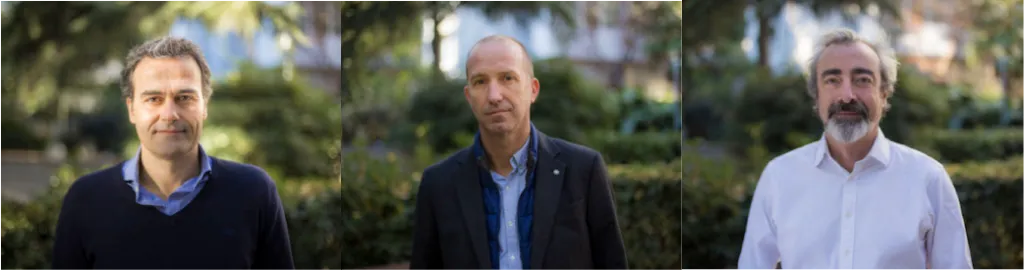
Carles Ferrer, Daniel Sánchez and Jordi Viñas – General Partners at Nauta Capital
Nauta Capital was born in 2004 as an initiative by the founders of the consulting firm Cluster after it was sold to Diamond Consulting Partners. Currently on the management team of this venture capital firm we find Jordi Viñas, Carles Ferrer and Daniel Sánchez. Specialised in investing in early-stage B2B tech startups, they have offices in Barcelona, London and Munich to cover the European market. You can apply to their investment fund via the following link.
If you want to know more about Nauta Capital’s modus operandi, you can listen to the Itnig podcast episode: Nauta Capital & Active Venture Partners on metrics, entrepreneur execution and the EU VC scene.
Markets: Spain, United Kingdom and Munich
Sector: B2B software technology
Stages: Startups
Capital raised: 120M€
Portfolio: 47 companies, 10 exits
Contact: +44(0) 203 553 5757 (London); +34 935 035 900 (Barcelona)
KIBO VENTURES
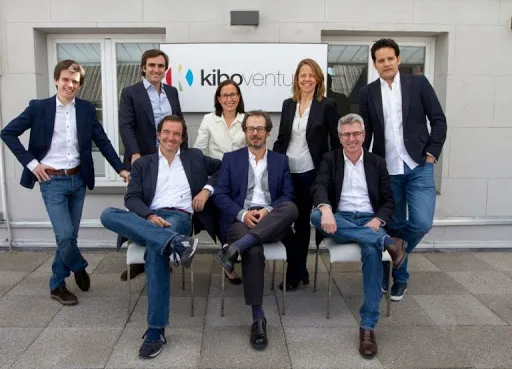
Kibo Ventures team
Kibo Ventures was founded by Aquilino Peña, Javier Torremocha and José María Amusátegui in 2012. It currently has offices in Madrid, Barcelona and Lisbon. This venture capital firm backs early-stage startups focused on technology. Although they want to be the go-to investor for entrepreneurs on the peninsula, they’ve invested in companies at the international level.
Markets: Europe, United States, Latin America
Sector: Technology, Fintech, Big Data, AI, Logistics, Healthcare and Education
Stages: pre-seed, early-stage
Capital raised: 100M€
Portfolio: 77 companies, 9 exits
Contact: info@kiboventures.com
SAMAIPATA

José del Barrio and Eduardo Díez-Hochleitner – Founders of Samaipata
Samaipata was founded in 2016 by José del Barrio and Eduardo Díez-Hochleitner, headquartered in Madrid, Paris and London. The venture capital firm specialises in investing in digital platform and marketplace startups at pre-seed and seed stages, with presence in southern Europe (France, United Kingdom and Germany).
To apply for their investment fund as an entrepreneur, you can fill out the form found at the following link.
Market: Europe
Sector: Digital platforms, Marketplaces
Stages: pre-seed, seed
Capital raised: 100M€
Portfolio: 17 companies, 1 exit
Contact: +34 914 346 544
SEAYA VENTURES
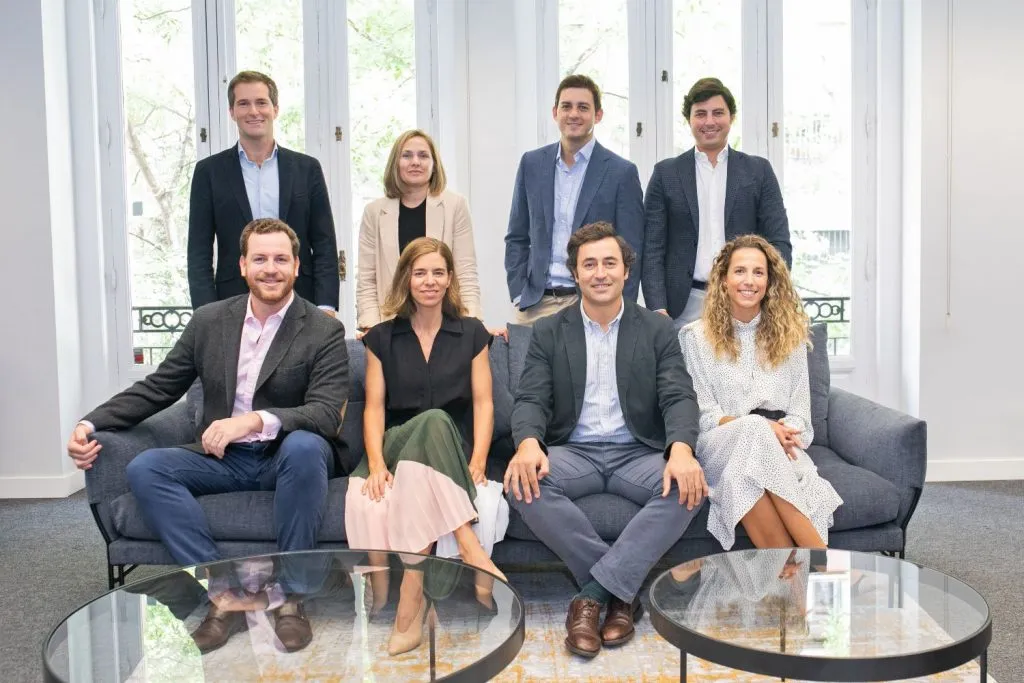
Seaya Ventures team
Seaya Ventures was founded by Beatriz González in 2013. It’s one of the leading venture capital firms in Spain, known for being one of the first investors in the promising Spanish startups Cabify and Glovo. The group specialises in tech startups at early-stage and growth phases.
By filling out the following form, Seaya Ventures will analyse the project and get in touch with you.
Market: Europe
Sector: Technology, Healthcare, Education, Finance
Stages: Early stage, Growth
Capital raised: 85M€
Portfolio: 22 companies, 5 exits
Contact: +34 911 108 697
K-FUND
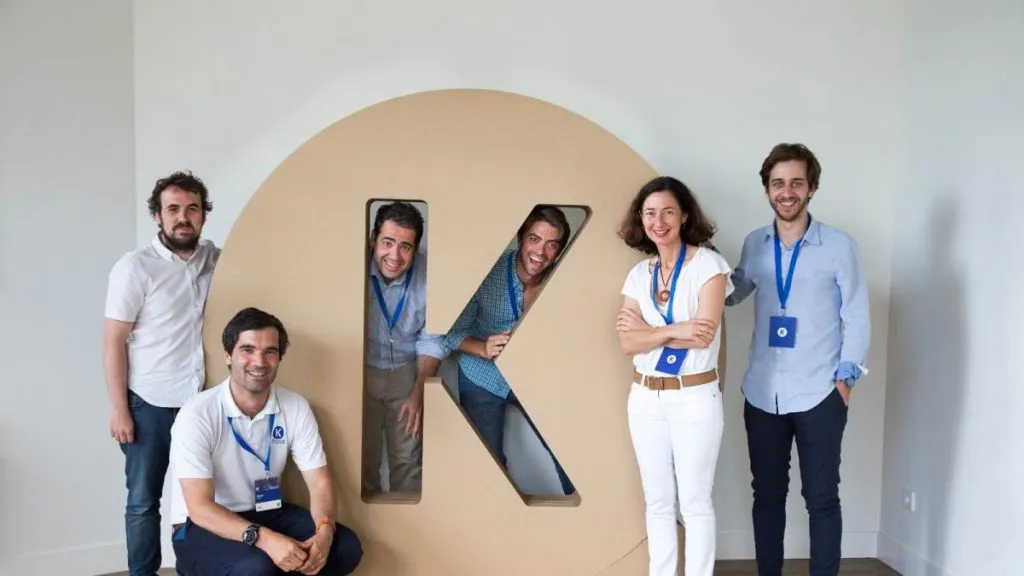
K-Fund team
K-Fund was founded in 2016 following a founder-centred philosophy. The company backs both Spanish and Portuguese entrepreneurs who have created tech solutions focused on both B2B and B2C. The investor group contributes not only financial capital to the startup but also new contacts/clients and advice to help grow the project.
If you’re looking for investment and think K-Fund can help you, fill out the following form.
Market: Europe
Sector: B2B and B2C products, technology
Stages: Seed
Capital raised: 85M€
Portfolio: 31 companies, Factorial among them
MUNDI VENTURES

Javier Santiso – Mundi ventures
Mundi ventures was founded by Javier Santiso, and currently has two investment funds. On one hand there’s the Alma Mundi Fund which specialises in B2B tech startups at any stage looking for Series A financing. This fund is headquartered in Madrid, but has secondary offices in Barcelona, London, New York and Seattle. Its investors come, besides from the cities where they have offices, from San Francisco, Paris, Amsterdam, Stockholm, Geneva, Brussels, A Coruña and Bilbao among others. On the other hand, Alma Mundi Insurtech Fund focuses on investing in companies at seed and early-stage phases looking for seed capital, Series A and B financing. It’s also headquartered in Madrid, with secondary offices in Barcelona and Tel Aviv.
Markets: Europe, Israel, United States and United Kingdom
Sector: Insurtech and B2B technology
Stages: Seed, Early stage and Growth
Capital raised: 70M€
Portfolio: 40 companies
JME VENTURES
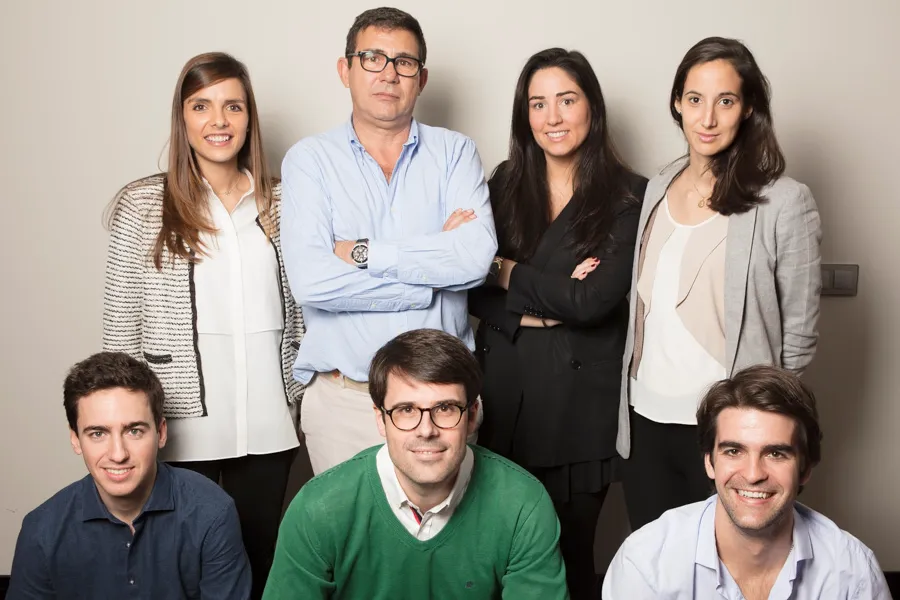
JME Ventures team
JME Ventures is an investment fund founded by Javier Alarcó and José Manuel Entrecanales. The company focuses on investing in tech-sector startups with both B2B and B2C business models that require investments between 500.000 and 4 million euros. JME’s stated goal is to invest in around eight startups a year to achieve an exit within five to seven years.
Market: Spain
Sector: Technology
Stages: Early-stage
Capital raised: 56M€
Portfolio: 42 companies, 7 exits
Contact: backme@jme.vc
ITNIG FUND
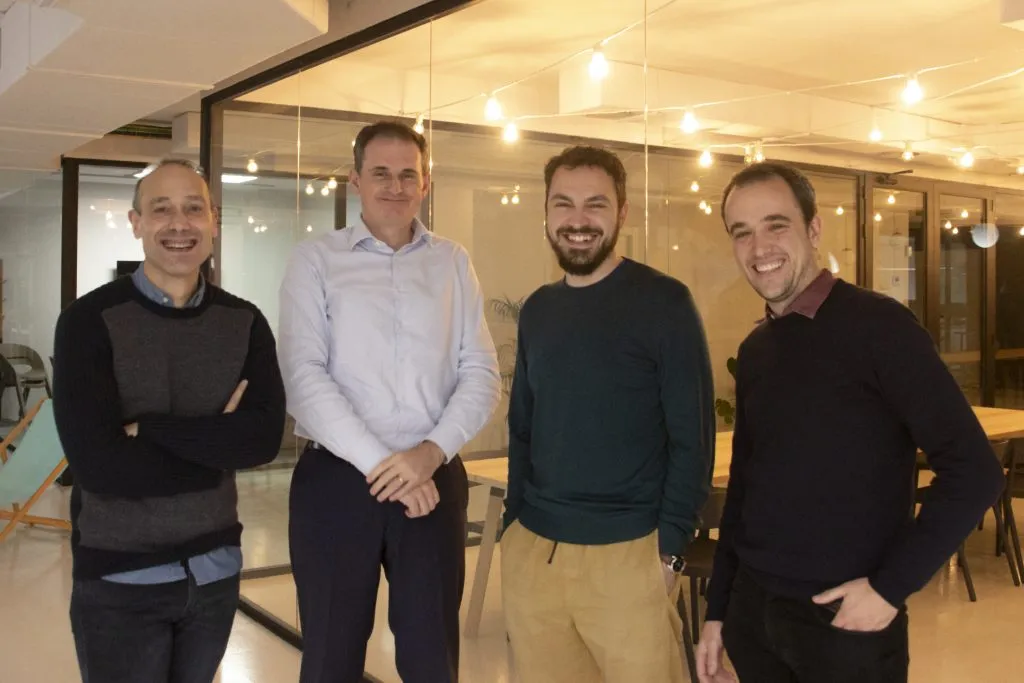
Juan Rodríguez, Albert Domingo, Jordi Romero and Bernat Farrero – Itnig Fund
Itnig was founded in 2009 as a bet on technology. Based in Barcelona, we aim to build a startup ecosystem both at the Spanish and European level, helping entrepreneurs develop their tech solutions. You can apply both to our investment fund and to our coworking space in Barcelona to enjoy our spaces and coffee provided by Syra Coffee.
You can also learn with us about financing, startups and technology by listening to our weekly podcast.
Market: Europe
Sector: Technology
Stages: Early-stage
Portfolio: 12, 2 exits
Contact: +34 930 008 494
Discover more about Itnig on our website and stay up to date by subscribing to our newsletter!
