1st Anniversary of Qonto in Spain: Interview with Carles Marcos i Guàrdia
Qonto's first anniversary in Spain has arrived, and at Itnig we invited Carles Marcos i Guàrdia to tell us about the neobank's trajectory and future plans.
Qonto’s first anniversary in Spain has arrived, and at Itnig we invited Carles Marcos i Guàrdia to tell us about the neobank’s trajectory and future plans.
What is Qonto and how does it work?
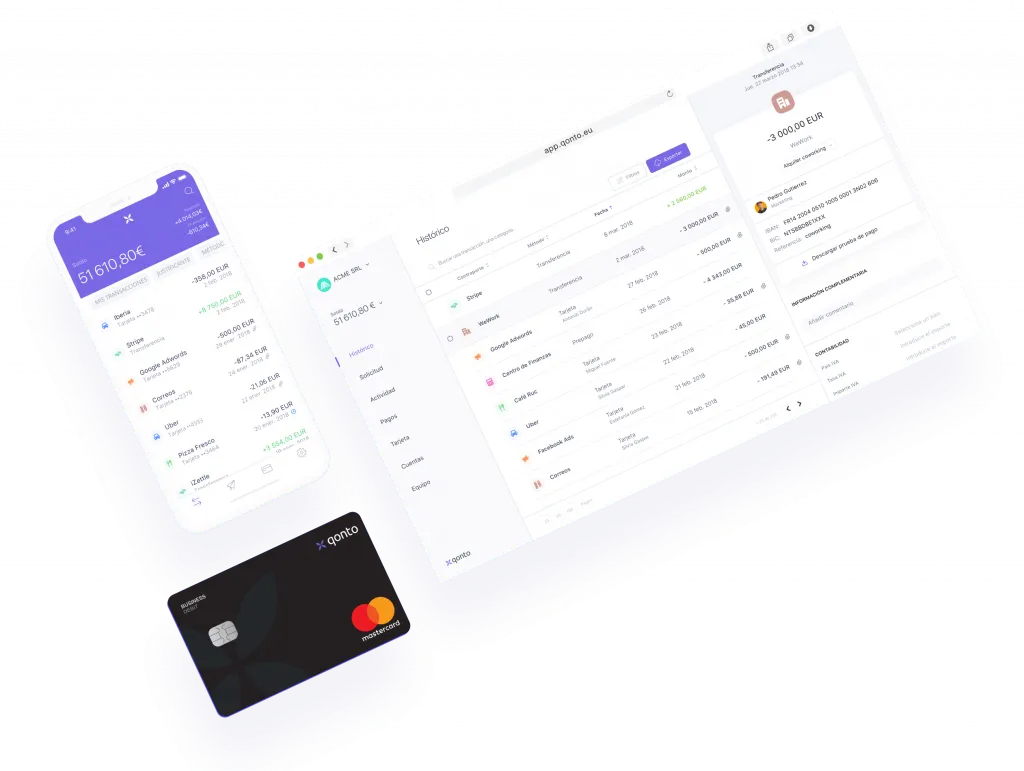
Carles: Qonto is a neobank, and what sets us apart from other banks, let’s say, is that we’re focused solely on freelancers, entrepreneurs and SMEs — we’re a B2B bank. What we do is offer a bank account that can be opened in ten minutes, completely online, and with that bank account you can have linked cards. What we make easier is the day-to-day financial management, so that people can control all their finances from the web app or from the mobile app.
So, in terms of what sets us apart from a more traditional bank or from other banks, I’d say first of all there’s the whole UX side. What we try to do is make our product very simple to use, whether it’s a user who has years of experience with a banking product and understands finances very well, or a team member who just needs to spend with their card and understand the expenses they’re making day to day. Second, there’s the relationship we have with our customers, the customer service. What we see is that for years banking has related to customers through physical interaction. You have to go to the branch, do most of your paperwork there.
At Qonto, on the other hand, we do everything completely online. It’s our commitment to respond to you in less than 15 minutes, whether by phone or by email. That’s really something different, especially because the segment we’re targeting is entrepreneurs. They generally have little time, and what they really care about is that we solve all their problems quickly and easily. And third, there’s the pricing side, which in traditional banking is often hard to understand — what your bank is actually going to charge you. You always get hit with something one month, or a fee you don’t quite understand, and you have to go ask or complain to find out exactly what it’s about.
Here, we also try to completely change the paradigm, and what we do is offer a monthly plan based on the size of your company, based on the number of cards you’re going to need. And you know that what you pay each month covers a set of services, and that we’re never going to charge you any kind of hidden fee. So we’re more like a banking Netflix, where you know what you’re going to pay month to month. That’s predictability, and also peace of mind, knowing we’re not going to charge you for services you don’t use or don’t understand.
Qonto in Spain
We started here in Paris, and it was founded by Alex and Steve, who are the founders. They had previously founded their own company, called Smokio, a mobile app. And when they sold that business in 2015, one of the problems they’d noticed while running Smokio was that opening a bank account was a terrible experience.
Afterwards, every time they had to interact with their bank, it was also a nightmare. They lost a lot of time, they didn’t quite understand how to solve the problems they had. So when they sold the company, they decided to start something new because it had worked out so well for them, and that’s how Qonto was born, launching the product in the summer of 2017, so we’ve been around for less than three years. And since then, last year was the year of international expansion, when we launched in Spain, Germany and Italy.
And you’ll probably ask me about the funding rounds and the money we’ve raised so far. We’ve had a good track record of funding year after year. The truth is that the funding round isn’t the success itself — the success is the investors who come in and trust our project. Since 2017 we’ve reached 75,000 customers. The particularity, as I said before, is that they’re paying customers, because all Qonto customers pay their monthly fee, which means there are customers who are very attached to our product and use us.
And to date we’ve raised 136 million in total. The last funding round was in January this year, right before COVID19. In terms of timing, it worked out pretty well for us, and it was a Series C of 104 million. The particularity is that fintech, and neobanks in general, are known for raising fairly large funding rounds. In our case, what stands out is the speed. Two and a half years, and we’re already at a Series C round of more than 100 million.
It shows we have a strong track record of customer acquisition and also of revenue, and that’s what should help us consolidate the markets where we’ve launched, and we’ll keep going. Especially now, I haven’t mentioned this, but we have a payment license. At the banking level this limits the type of products we can offer our customers, but the idea is to launch.
First we need authorization from the Bank of France, but we’re aiming to get the credit license by the end of this year so we can offer products that are quite important for SMEs, such as financing, credit cards, factoring, etc.
What is the 104 million going to be invested in?
Carles: Well, mostly it’s going to go towards expanding the team, especially the product team. The roadmap we have is huge, and we have a lot of priorities and a lot of opportunities for improvement in that area, so obviously we’re going to grow the team, especially on the product side. It’s going to let us acquire customers faster, or rather accelerate growth in the markets where we’re already present. Also, when it comes to obtaining the credit license, there are a series of requirements from the regulator that, with this funding round, we’ll obviously be able to cover comfortably.
After this first year in the Spanish market, what have some of the initiatives been?
Carles: We launched in the Spanish market in June last year, and basically what we did was the localization effort, because we had a product that worked very well in France. The first step was, okay, let’s localize it, let’s make the adaptations we need. The minimum needed to launch in Spain, and the first months were mostly about capturing the first customers — before the launch we already had beta customers testing the product for a few months. But it was mainly about really understanding where our value proposition stood, which segments we were going to focus on within B2B banking.
And what the points of friction or product improvements were that we had to carry out to really get traction. Two stood out mainly: the first, which was a quick fix, was the VAT adaptation. When our customers spend with the Qonto card, the expense is automatically recognized, but by default we were applying French VAT. So obviously we had to adapt the product so that automatic VAT detection was adapted to Spanish VAT.
And second, probably the most common and most requested thing in the first months was the IBAN in Spain. To be able to launch quickly, we launched with a French IBAN which, in principle, under European regulation, shouldn’t have caused any kind of problem operating with a French, Italian, German, or any other country’s IBAN. What happened is that we found friction mainly in two areas. The first is that our customers didn’t like giving their own customers a French IBAN to pay into, for reputation reasons. That was more of a psychological issue that they didn’t like.
And second, technical restrictions they ran into, especially when making direct debit payments or paying suppliers. Often, to sign a direct debit mandate, the format required by a phone company or an energy company already required the ES format at the start of the form.
This restricted the possibility of using a French IBAN. Also, the French IBAN has three more digits than the Spanish one. So, well, we managed to get the Spanish IBAN. In November we started testing, and we launched at the end of January or beginning of February, and since then we’ve really seen that, in terms of acquisition and especially in terms of the complaints our existing customers had, they’re now much more loyal.
Qonto card
How are you celebrating this anniversary?
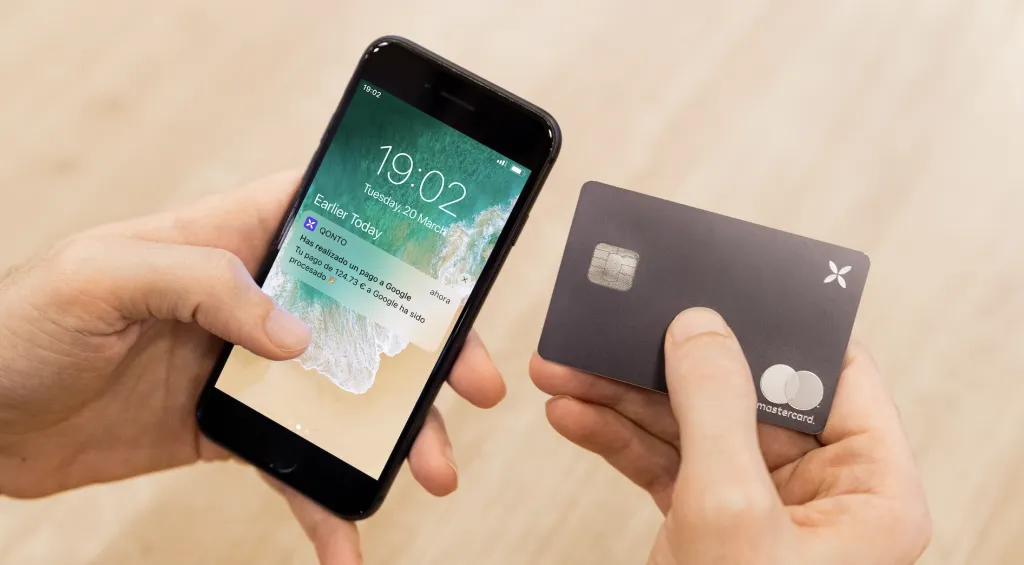
Carles: Well, we turn one this Saturday, and obviously no one’s going to be working on Saturday, so we’re celebrating this week, the week of June 15th, and we’re going to run different promotions and initiatives. One of them is going to be giving 2 months free trial with a code that we’ll probably announce on social media. Then, since our customers are companies, many of them have offered to provide services and promotions. Some will be marketing tools and other services. And finally, one of the most anticipated things, because we ran out of stock, is the metal card.
Qonto was the first B2B neobank to offer a metal card, and we were victims of our own success because our stock forecast was terrible, and in February, when we launched it, we ran out and had to reorder. With COVID19 there were production delays, etc. And now we finally have metal cards available again, and we’re going to raffle off a few among our customers and also new customers who sign up so they can get one.
With the COVID19 situation, do you think Qonto is going to come out stronger, given that the customers you have are the ones you have?
Carles: The surprise was that during COVID19 we were expecting the worst. In the end I think every company made three different forecasts for the end of the year, adjusting budgets, adjusting projections.
In our case, obviously our revenue, as I mentioned before, comes from the monthly fee. Then we have revenue from partners we’re associated with, and finally an important part of the revenue also comes from what we get from our customers’ spending with the Qonto card. So especially in the months of March, when it started, and the last weeks of March and April especially, our customers were spending less. Which affected our revenue.
The surprise was that in May it went up remarkably, and in terms of new customer acquisition, honestly we didn’t see any kind of slowdown. Quite the opposite. Many companies at that point were looking to open a bank account, and doing the whole process 100% online, in less than 10 minutes, is a notable advantage. And in April, May and June we’ve seen pretty good growth in acquisition.
In a way, it’s benefited us by speeding up the change in habits among our entrepreneurs, who maybe before COVID viewed neobanks or digital banking with a bit of suspicion or distrust, pushing them to try new things because it clearly offers solutions in moments of crisis like the ones we’re going through.
Subscribe to the channel and don’t miss our weekly podcast!
Itnig is a Barcelona tech startup ecosystem, creators of Camaloon, Quipu and Factorial, among others. We offer more than 3,500 square meters of coworking for startups and we organize daily events to discuss business and technology to the fullest. Through itnig fund we invest in teams capable of building great products and businesses.